Thursday, December 8, 2011

Why Digital Comics Won't Take Over

        Digital comics is a topic that is near and dear to my heart. On one hand I love the idea that we are a finally moving towards that "flying car" idea from when I was a kid. I feel like we are getting to the point that we are in the "future", and not fooling around in the past with large clunky cameras with disposable film. Instead we have developed sleek touchscreen devices sporting an almost unlimited roll of film and filters that can take a picture and upload to your social networking profile with the touch of a few buttons. It is crazy for me to think that in the span of my life I've seen the birth, and growth of the internet that we know of today. It is also a bit tough for me to think that comics, something I loved reading when I was a kid, are slowly disappearing. Or are they?
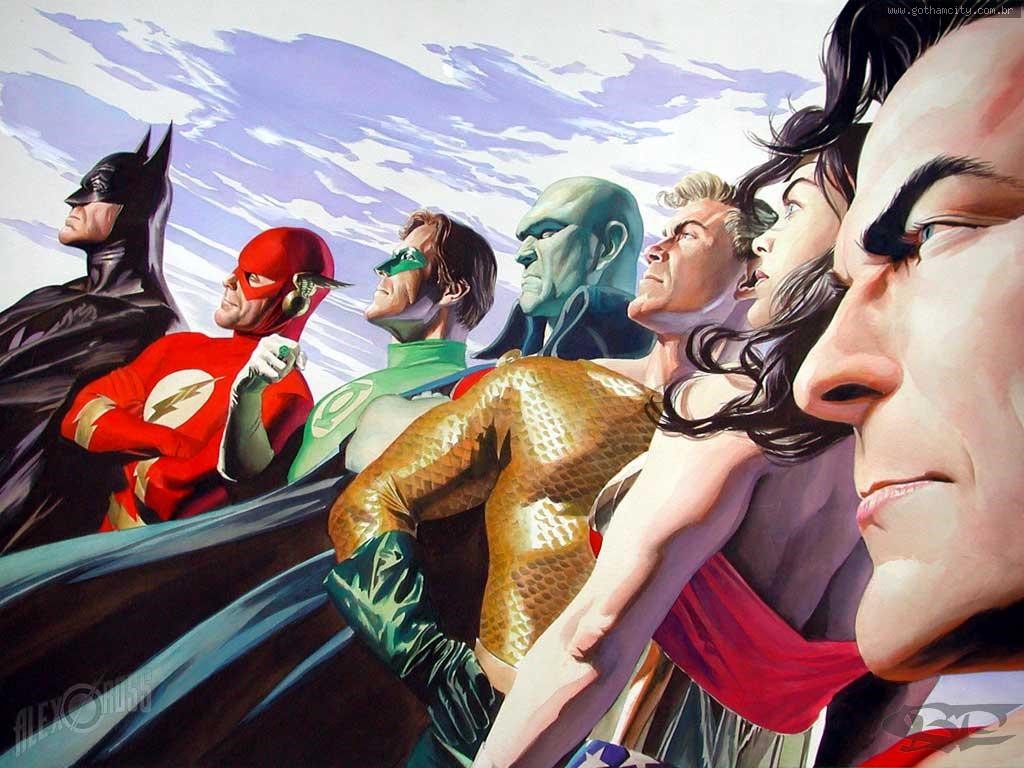
© DC Comics and Alex Ross
       To me the birth of digital comics is almost bittersweet. It allows me to keep multiple comics on hand on a tiny device that can fit into my bag (or pocket) that I can read at any time. I couldn't carry more than three comics on me at any one time, and if you like comics like I do you know that three comics are MAYBE 30 minutes of reading. Being an artist I like to admire the pictures. That brings up a space issue. Digital saves space. This idea applies to ALL digital formats of things. It makes it a tough choice, but I must say nothing beats holding a comic in your hand. This is the biggest fight against digital (for books and comics). Turning the last page is the most rewarding experience for any comic reader. I don't feel like I get that same feeling after I finish a digital comic. I am someone who loves to embrace this whole digital age, but space is not something I care about in comparison to holding a real comic.

Art by Sean Phillips
        Digital does however allow opportunity. For someone like me who makes my comics independently (outside of any major publisher) digital allows me to get my comics out to people who may actually want to read them. This is an opportunity I wouldn't be given by Diamond Distribution, or any of the large publishers like Marvel, DC Comics, IDW, Darkhorse, or Image. This is a point that can't be overlooked if you are a creator. However, again nothing beats print. Anyone can publish their comic online. That doesn't mean it is good. The same is also true about print. Anyone can publish their comic in print too...for a price. While this doesn't mean it is good, it takes a lot more commitment to print something because now you are talking money, time, and effort. This is what I did recently with the first chapter of my comic The Jacket. We (my friend Jason and I) published it in both digital and print formats. We even made a short live-action film. We took it to Baltimore Comic-Con in August 2011 and while not extremely successful, it sold nicely for us. From my experiences at the past few Baltimore conventions I can say that print comics are very much alive and not going anywhere. Last year when Stan Lee was making a guest appearance (if you missed him he'll be back this year...so will we!) I saw more people than I could even imagine. All of them, comics in hand waiting to get them signed. This presents another problem in and of itself.

Image courtesy of Google © Whoever took it
        While I won't go too in depth because I want to wrap this blog up, I feel like digital will destroy the ability to get your comics signed, and ultimately make conventions a thing of the past. That would kill me. Print will always prevail because nothing makes digital copies of comics unique. You can't get a signature, you can't send it away to the CGC for a grade, you can't keep a pristine copy for 20 years until it is worth something, and you can't even sell it secondhand without selling your whole device even if you did keep it for 20 years. Not to mention the fact that it only takes one drop to the floor and your whole collection is gone. What makes that special? I am one who always buys collector's versions of things. It makes me feel like I have a one-in-a-million item. I know inside that it isn't true, but I can't help it. Just taking a look at the image above though, would you want to see that disappear? As a comic fan and creator, this is something worth living for. Being connected to thousands of people who care about the same thing you do. Embracing them and the item that holds you all together. Digital comics, on some weird level, may help you find friends through Facebook, but it will never help lead you to a convention of people just waiting to talk to you about your love for funnybooks. 

        We are so wonderfully connected through these things called comics, and there is no way anyone can take that away. I don't care how hard these companies push digital. While I may buy some comics in digital format, if I really want to READ it...I'll buy it in print.

Monday, November 21, 2011

My Work Process

        When I was a little kid, it was always so hard to understand how people finished artwork. I knew being a lover of Pokemon, comics, and cartoons that I loved drawing. I just never knew how to get to the final product. Most of the time I just copied things from my Pokemon video game guides. I'd look at the Sonic the Hedgehog cover art and copy Sonic line for line. Then I had access to a computer and started drawing in MS Paint. I still never knew how to finish a piece. So, I thought I'd show you that I've finally learned. While this is a way for me to assess my abilities and work flow, it is also me putting myself out to the people who don't know how to finish a piece of art. Maybe this will help you be able to find a way for you to finish your own piece. I figured I'd start with a piece I mentioned in my last post.
The sketch phase

        This is a playbill piece for the Broadway Theater in Pitman, NJ. The play is titled "Monster Mash". To the right is my initial sketch (after many little sketches and a few failed thumbnail sketches) for the final piece. I guess I'll just jump right in. After looking at it a bit, my teacher and I agreed that Frankenstein's monster was a bit too short. He needed to tower over the others to be a bit more believable. I was trying to go for a more family-esque looking team of monsters. This was for a children's theater show after all. I tried to make them all buddies, and even tried to make the wolf-man into more of a wolf-boy. So, after the sketch, I took it into Photoshop and cut out Frankenstein's monster and moved just is upper half up. I figured I could just paint in the rest.
The underpainting phase


        To the left is the second step, and then some in most areas. Here I am showing how I block in colors, and textures so that I can get a good sense of what the darks and lights will eventually be. What I mean is once I establish the middle green, then I know to make that green darker or lighter in the instance of painting Frankenstein's monster's face. It helps to keep the whole piece and its parts cohesive. This is also the step where I finalize a lot of key fixes from the sketch. I noticed that I actually didn't like the point on top of Dracula's head so I smoothed it over in the painting. There were also minor fixes done here like the bolts on Frankenstein's Monster's neck.


Final choices stage
         This is the stage where I make all lighting decisions and color decisions final. I make sure that all the colors are filled in, the linework and shapes are solid, and that everything is painted to the same level of completeness. I drop in a background color too. I knew from the start that I wanted them to be in front of a night sky with lightning striking behind them. I needed to find a dark blue color that I liked enough that wasn't too dark or too light and that worked with the rest of the colors. I felt this was a pretty solid blue with a hint of purple (a very indigo color) since my reference photos of night skies had hints of many cool (temperature) colors. With all character choices finalized I move on with the background.

The final image


        To the left here I've added some clouds, lightning, and the moon. Textures are all finished and established. I referenced about 20 different pictures of lightning before I got the look and feel that I wanted. In Photoshop, I just added a glow effect to the lightning to help bring it out in the sky. Same thing for the stars and the moon. It helps to reinforce the lighting of the characters in the front. They are lit up a bit too much, but the lightning has a pretty good ability of throwing light and reflective light around.

        While this image was not selected for print by the theater, this was one of my more favorite pieces of the three that I did. I feel I am starting to evolve my style into a more digital workflow. I am pushing painting concepts that I otherwise had a hard time doing with real paint. While this piece doesn't deviate too far from my normal work, it helped me to open up to a new way of digitally working. Don't believe me? Just look back through this blog and you'll see what I mean. Thanks for reading if you've made it this far. If you have any comments or questions, leave them in the comments section. Also, if you have an idea of what my next blog post should be, leave that in the comments too. I'd love to hear some people's ideas!

Tuesday, November 8, 2011

Animation: A Huge Help

        I've always been a fan of cartoons. From comics to Saturday mornings, they've fueled my desire to learn art. I've always preferred the still-image, but recently (thanks to school) I've dabbled in animation.  


        The animation above is a pencil test that I've done recently to illustrate a character walking into a room, opening a box, and reacting. This is the sort of thing that I grew up wanting to do. It has gone beyond that now. I've reached a point where animation wasn't a means to an end, but rather the beginning of something new. It helped me to harness a few different abilities; like being able to draw something consistent and quick, and learning to harness motion on a still piece of paper. These I feel are key traits to any comic artist. 

        This kind of animation work lent me a new skill: cartooning. I've never really had a fine art ability. Things like painting always evaded me. That was until animation (and my instructor Matt Novak) opened my eyes to how it could help enhance my other skills. Take the digital painting on the left. It showcases both my love of illustration, and my skills learned in animation. Along with all of my illustration teachers, I have been able to hone my skills at painting, cartooning, and drawing in general.

A playbill illustration for a play titled "Monster Mash"
        Comparing the illustration on the left, the Dracula character essentially is the grown-up form of the kid in the animation. This was a way for me to carry over characters and even re-imagine them. It ultimately does what I want to do with my art...tell stories. 

       My whole point to this post is to do anything you can. Don't worry if it has anything to do with what you want to do, it will certainly assist you and give you skills you never thought it could. While animation is all about drawing a lot, I never thought about how it would push my illustrations even further. I thought it would just be another avenue that would have a dead end where I would move on and keep doing still images. I didn't realize it was a hallway with an open door.